All published articles of this journal are available on ScienceDirect.

Influence of Environmental Factors on Biofilm Formation by Heat-resistant Spore-forming Bacillus cereus TGS11.1
 iD
Bich Hanh Bui Thi1
iD
Thanh Huy Tran Huu1
iD
The Vinh Bui1
iD
Thi-Kim-Dung Hoang2
iD
Khoa Anh Ton1
iD
iD
Bich Hanh Bui Thi1
iD
Thanh Huy Tran Huu1
iD
The Vinh Bui1
iD
Thi-Kim-Dung Hoang2
iD
Khoa Anh Ton1
iD
Authors Info & Affiliations
Abstract
Introduction/Objective
This study evaluates the synergistic influence of environmental factors on the biofilm formation capacity of the heat-resistant, spore-forming pathogen Bacillus cereus TGS11.1 within milk-processing contexts.
Methods
Response Surface Methodology with a Central Composite Design (RSM-CCD) was implemented to quantify the multifactorial effects of temperature (30–70°C), pH (4–8), lactose concentration (2–6%), and incubation time (12–60 h) on biofilm development using optical density measurements and phenotypic motility assays.
Results
Temperature emerged as the dominant determinant of biofilm formation, with peak productivity and OD570 values occurring at 40°C, correlating with maximum swarming motility and the establishment of a dense three-dimensional (3D) architectural network.
Discussion
The observed sensitivity of B. cereus to thermal gradients and nutrient availability underscores the need for multifactorial intervention strategies to disrupt the structural resilience of the biofilm matrix during dairy production.
Conclusion
Mitigating recontamination risks in dairy workflows necessitates the strict avoidance of thermal niches near 40°C to inhibit the optimal physiological conditions for robust biofilm formation by B. cereus TGS11.1.
1. INTRODUCTION
The contamination of raw milk by Bacillus cereus constitutes a critical biosafety risk primarily due to the production of heat resistance spores that facilitate enzymatic spoilage and the synthesis of emetic and diarrheal toxins [1]. This microbiological challenge is intensified by the capacity of B. cereus for biofilm formation on dairy contact surfaces, where the protective extracellular matrix confers significantly higher resistance to detergents and disinfectants compared to planktonic populations. Notably, biofilm-associated spores exhibit heightened thermal resistance, leading to post-pasteurization recontamination and diminished product shelf life, which subsequently incurs substantial economic losses for the dairy industry [2]. Characterizing the non-linear interactions between multiple environmental factors, specifically nutrient concentration, temperature, incubation time, and pH, is imperative for understanding biofilm formation under actual milk processing conditions. While the hazards of B. cereus are well-established [3, 4], current literature has predominantly investigated these variables in isolation, leaving their simultaneous synergistic effects largely uncharacterized [4]. Furthermore, the assessment of colony morphology provides essential visual metrics regarding the structural complexity and architectural integrity of the biofilm, facilitating the evaluation of bacterial pathogenicity and risk levels within dairy production workflows [5]. This study utilizes Response Surface Methodology with a Central Composite Design (RSM-CCD) to model the multi-factorial influence of environmental factors on the biofilm formation of B. cereus TGS11.1 [6]. The resulting data establish a deterministic framework for optimizing control strategies to mitigate microbial persistence and resistance during the processing and preservation of milk and dairy products [7].
2. MATERIALS AND METHODS
The study utilized the Bacillus cereus TGS 11.1 strain, which was previously isolated from raw milk samples in the Mekong Delta, Vietnam, as reported in our preceding study published in this journal. This specific isolate was selected for its superior heat-resistant, spore-forming capability among the collected strains. The use of TGS 11.1 ensures experimental consistency and allows for a deeper investigation into its biofilm-forming characteristics under the currently defined conditions.
2.1. Experimental Design
Biofilm formation of the Bacillus cereus TGS 11.1 strain was quantified using OD values. The investigated factors, including lactose concentration, temperature, incubation time, and pH, were selected based on small-scale industrial production processes to ensure that all parameters are adjustable under current operational conditions. RSM-CCD was applied, comprising 4 factors and 5 levels (Table 1). This approach significantly reduces the number of required experiments compared to a full factorial design. Furthermore, it avoids extreme treatment levels that are often impractical for small-scale laboratory settings. The design aligns with actual production conditions, ensuring that the model accurately reflects its potential for future practical applications.
| Runs | Factors | OD570 | |||
|---|---|---|---|---|---|
| Conc (%) | Temp (°C) | Time (h) | pH | ||
| 1 | 3 | 40 | 24 | 5 | 0.019 |
| 2 | 5 | 40 | 24 | 5 | 0.148 |
| 3 | 3 | 60 | 24 | 5 | 0.020 |
| 4 | 5 | 60 | 24 | 5 | 0.108 |
| 5 | 3 | 40 | 48 | 5 | 0.179 |
| 6 | 5 | 40 | 48 | 5 | 0.242 |
| 7 | 3 | 60 | 48 | 5 | 0.058 |
| 8 | 5 | 60 | 48 | 5 | 0.064 |
| 9 | 3 | 40 | 24 | 7 | 0.052 |
| 10 | 5 | 40 | 24 | 7 | 0.979 |
| 11 | 3 | 60 | 24 | 7 | 0.013 |
| 12 | 5 | 60 | 24 | 7 | 0.077 |
| 13 | 3 | 40 | 48 | 7 | 0.266 |
| 14 | 5 | 40 | 48 | 7 | 0.706 |
| 15 | 3 | 60 | 48 | 7 | 0.033 |
| 16 | 5 | 60 | 48 | 7 | 0.035 |
| 17 | 2 | 50 | 36 | 6 | 0.073 |
| 18 | 6 | 50 | 36 | 6 | 0.066 |
| 19 | 4 | 30 | 36 | 6 | 0.713 |
| 20 | 4 | 70 | 36 | 6 | 0.502 |
| 21 | 4 | 50 | 12 | 6 | 0.260 |
| 22 | 4 | 50 | 60 | 6 | 0.119 |
| 23 | 4 | 50 | 36 | 4 | 0.065 |
| 24 | 4 | 50 | 36 | 8 | 0.074 |
| 25 | 4 | 50 | 36 | 6 | 0.063 |
| 26 | 4 | 50 | 36 | 6 | 0.061 |
| 27 | 4 | 50 | 36 | 6 | 0.072 |
| 28 | 4 | 50 | 36 | 6 | 0.060 |
| 29 | 4 | 50 | 36 | 6 | 0.071 |
| 30 | 4 | 50 | 36 | 6 | 0.069 |
2.2. Quantification of Biofilm Formation Capacity under Various Experimental Conditions Bacterial Culture and Sample Preparation
The Bacillus cereus TGS11.1 strain was activated on Luria-Bertani (LB) agar (10 g L−1 tryptone, 5 g L−1 yeast extract, 10 g L−1 NaCl) and pre-cultured in 20 mL Brain Heart Infusion (BHI; Oxoid) medium. Secondary cultures (50 mL BHI supplemented with lactose (2%–6%)) were adjusted to pH levels (4–8) with initial OD0 = 0.1 and incubated at 37°C and 200 rpm for 3 h. Subsequently, 200 µL aliquots of fermentation broth were transferred to 96-well plates and incubated at temperatures of 30°C–70°C for durations of 12 h–60 h. To ensure biological and technical reproducibility, all experimental conditions were performed in three independent sessions (n=3), with each session comprising triplicate samples.
2.3. Evaluation of Biofilm Formation
Biofilm formation was quantified using the crystal violet staining method with modifications [3]. An aliquot of 200 µL of each sample was transferred into a 96-well plate and incubated statically at 37°C for 24 h. After washing with 200 µL PBS 1X, biofilms were fixed with 100 µL methanol for 15 min, stained with 1% crystal violet (250 µL), and subsequently solubilized with 250 µL of 95% ethanol. OD570 was measured, and biofilm production was classified relative to ODc (ODC + 3×SD): non-producer (OD ≤ ODC), weak (ODC < OD ≤ 2×ODC), moderate (2×ODC < OD ≤ 4×ODC), and strong (OD > 4×ODC). ODC (OD control) refers to the mean absorbance of negative control wells; SD denotes standard deviation. All reported values are presented as mean ± standard deviation (SD) of the three independent replicates. Wells containing sterile BHI medium served as negative controls.
2.4. Morphological Characterization of the Bacillus Cereus TGS 11.1 Strain’s Colony Biofilm under Different Temperature Conditions
To perform this survey, liquid culture medium was prepared by transferring 20 mL Brain Heart Infusion Broth (BHI) into an Erlenmeyer flask and incubated at 37°C and 220 rpm for 24 h. Aliquots (3 μL) of the standardized overnight culture (106 CFU/mL) were spotted onto BHI agar plates (1.5% agar) to develop colony biofilms. The plates were sealed with Parafilm and incubated at different temperatures (30°C, 40°C, 50°C, 60°C, and 70°C) for 24 h. To ensure morphological consistency and statistical reliability, 10 colonies per treatment were monitored across three independent experimental sessions (n=3). Colony morphology at various temperatures was examined and documented using a DZ.1105 stereo zoom microscope equipped with a dedicated digital imaging system (Euromex, Arnhem, The Netherlands). Colony diameters and structural complexity were quantified using ImageJ software, and significant differences between treatments were evaluated using one-way ANOVA (p < 0.05).
2.5. Swarming Motility at Different Temperatures
Swarming motility was assessed across a range of temperatures (30°C–70°C). Briefly, 10 µL of a standardized overnight culture (106 CFU/mL) of Bacillus cereus TGS11.1 was inoculated at the center of semi-solid BHI agar plates (0.8% agar) supplemented with 5% lactose at pH 7. To ensure statistical reliability, swarming assays were performed in three independent experimental sessions (n=3), with each session utilizing triplicate plates. The plates were incubated at 30°C, 40°C, 50°C, 60°C, and 70°C for 36 h. Swarming zone diameters were measured in two perpendicular directions using a digital caliper. The mean values (mm) were reported as mean ± standard deviation (SD). Statistical differences in swarming migration between temperature treatments were determined using one-way ANOVA followed by Tukey’s post-hoc test (p < 0.05).
2.6. Statistical Analysis
All experimental sessions were conducted in three independent replicates (n=3), with each treatment performed in triplicate to ensure biological and technical reproducibility. Data from the Response Surface Methodology (RSM) were processed using Design-Expert software (version 13.0). Analysis of Variance (ANOVA) was employed to evaluate the statistical significance of the quadratic model, individual factors, and their synergistic interactions. The fitness of the model was rigorously assessed using the coefficient of determination (R2), adjusted R2, and the Lack of Fit test (where p > 0.05 indicated a non-significant lack of fit, confirming model adequacy). Furthermore, all graphical representations, including response surface plots, bar charts, and error bars, were generated using R software (version 4.5.1). For all tests, a p-value < 0.05 was considered statistically significant, and results are expressed as mean ± standard deviation (SD) [8–13].
3. RESULTS AND DISCUSSION
In this study, the variables were selected to align with the experimental conditions, enabling an evaluation of both the individual effects and the interaction terms of the variables within the investigated design space. Table 1 details the Central Composite Design (CCD) matrix along with the corresponding actual responses (OD570 values) obtained from the 30 experimental runs.
3.1. Experimental Validation of Optimized Conditions for the Bacillus Cereus TGS 11.1 Strain’s Biofilm Formation
Validation of the CCD experimental matrix established the optimal parameters for biofilm formation in Bacillus cereus TGS 11.1 through integrated spectrophotometric quantification and phenotypic microtiter plate analysis. Quantitative assessments confirmed peak biofilm density at 24 h incubation, 40°C, 5% lactose, and pH 7.0, yielding a maximum optical density (OD570) of 0.979. Statistical significance (p < 0.0001) underscores that this optimal intersection represents a deterministic synergistic interplay of environmental factors rather than stochastic variation (Fig. 1). Differential biomass accumulation in 96-well microtiter plates corroborated the statistical model through visible turbidity and surface aggregate density at the identified optima. Pre-staining observations revealed a significant contrast in cellular density between the optimal treatment and cultures subjected to acidic stress (pH 5.0) or limited carbon availability (Fig. 2a). Subsequent crystal violet (CV) staining demonstrated intense, uniform coloration in optimal wells, whereas control rows (3% lactose or pH 5.0) exhibited negligible dye uptake, indicating that peak adherence and architectural stability are contingent upon these specific parameters (Fig. 2b). The high congruence between morphological maturation and quantitative data (p < 0.0001) identifies the 40°C, pH 7.0, and 5% lactose intersection as a biological “sweet spot” for B. cereus TGS 11.1 At this physiological nexus, neutral pH and high carbon availability likely facilitate extracellular polymeric substance (EPS) synthesis by neutralizing cell surface charges and promoting initial attachment, as evidenced by the dense CV-stained pellicles (Fig. 2b). Conversely, the significant biomass reduction at pH 5.0 identifies acidic stress as a primary inhibitor, establishing environmental neutrality as a prerequisite for colonization. These findings extend current frameworks; the 40°C optimum aligns with reported thermal thresholds [14], while the pH 7.0 requirement confirms a physiological preference for neutrality despite a broad tolerance range [14]. Furthermore, the 5% lactose requirement of strain TGS 11.1, exceeding the 3% reported for other Bacillus biofilms [15], suggests a more robust carbon-induced EPS induction, underscoring the specialized persistence and resistance of this isolate in high-nutrient milk-processing environments.
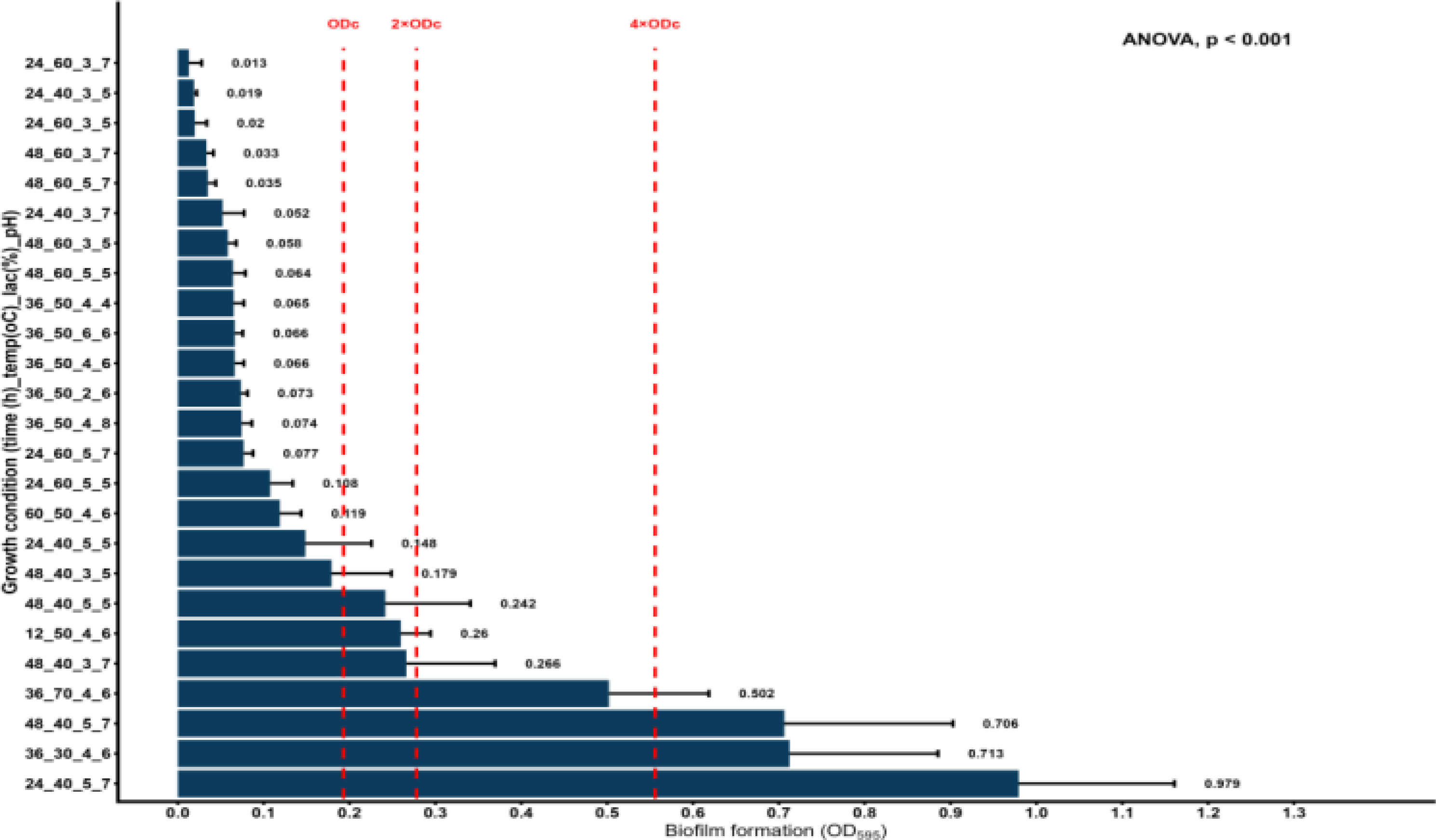
The optimal conditions for biofilm formation by the Bacillus cereus TGS 11.1 strain.
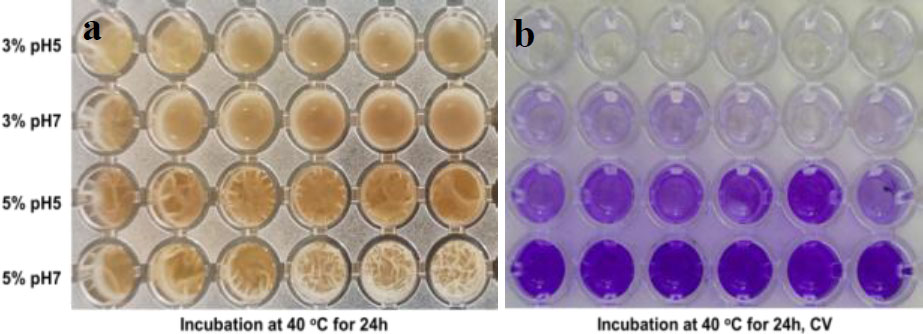
Biofilm formation under the experimentally optimized condition: a) visually biofilm formation; b) biofilm formation after CV staining.
3.2. Effects of Individual Factors on Biofilm Formation
The individual influence of each environmental factor on the biofilm formation capacity of Bacillus cereus TGS 11.1 was quantified using the Response Surface Methodology (RSM-CCD) framework. Initial ANOVA indicated that while incubation time (p = 0.8675) and initial pH (p = 0.0664) fell outside the standard 95% significance threshold, the discernible trend exhibited by pH in Fig. (3) necessitated its retention for model refinement. Consequently, the quadratic model was optimized to incorporate three primary variables: lactose concentration (A), temperature (B), and pH (D) (Table 2). The refined model confirmed that the selected parameters significantly modulated the optical density (OD) of the resulting biofilms as detailed in Table 2 and Fig. (3). Lactose concentration (A) exerted a significant positive linear effect (F = 7.67; p = 0.0112), driving a progressive increase in biofilm density as concentrations rose from 2% to 6%. Conversely, incubation time demonstrated negligible impact on the response, characterized by a stationary trend across the 12–60 h interval. Furthermore, pH (D) exhibited a significant positive linear correlation with OD (F = 4.74; p = 0.0404), following an upward trajectory from pH 4.0 to 8.0. Among the investigated variables, temperature (B) functioned as the dominant factor governing the biofilm formation process through a profound nonlinear influence(B: F = 17.90, p = 0.0003; B2: F = 29.21, p < 0.0001). Biofilm OD570 values declined within the 30–55°C range before increasing again up to 70°C. This U-shaped phenotypic response indicates a local optimum and highlights the significant thermal sensitivity of the isolate under milk-processing conditions.
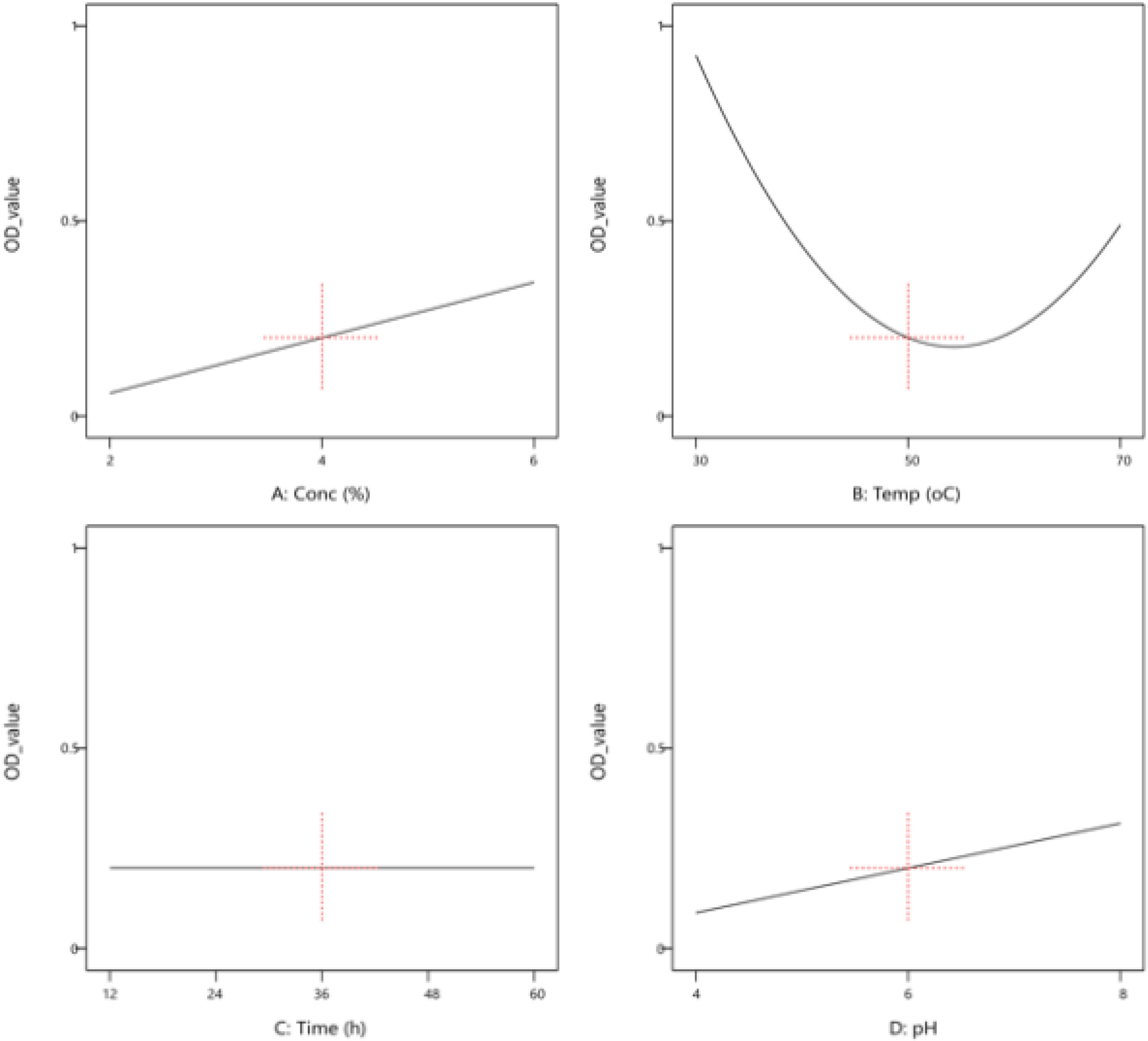
The impact of individual factors on biofilm formation ability of the Bacillus cereus TGS 11.1 strain.
| Source | Sum of Squares | df | Mean Square | F-value | p-value | Remark |
|---|---|---|---|---|---|---|
| Model | 1.29 | 7 | 0.1838 | 11.64 | < 0.0001 | - |
| A-Conc | 0.1211 | 1 | 0.1211 | 7.67 | 0.0112 | Significant |
| B-Temp | 0.2828 | 1 | 0.2828 | 17.90 | 0.0003 | Highly significant |
| C-Time | 0.0006 | 1 | 0.0006 | 0.0288 | 0.8675 | Not significant (removed) |
| D-pH | 0.0749 | 1 | 0.0749 | 3.92 | 0.0664 | Marginally significant (full model) |
| D-pH | 0.0749 | 1 | 0.0749 | 4.74 | 0.0404 | Significant |
| B.B | 0.4614 | 1 | 0.4614 | 29.21 | < 0.0001 | Highly significant |
| A.B | 0.1223 | 1 | 0.1223 | 7.74 | 0.0109 | Significant |
| A.D | 0.0822 | 1 | 0.0822 | 5.21 | 0.0326 | Significant |
| B.D | 0.1419 | 1 | 0.1419 | 8.99 | 0.0066 | Highly significant |
| Residual | 0.3475 | 22 | 0.0158 | - | - | - |
3.3. Interactive Effects of Dual Factors on Biofilm OD Values
Beyond individual parameter analysis, dual-factor interactions were evaluated to elucidate their synergistic influence on the biofilm formation process of Bacillus cereus TGS 11.1 ANOVA results (Table 2) confirmed the statistical significance of all three interaction pairs, with the temperature–pH interaction (B×D) exerting the most profound influence (F = 8.99; p = 0.0066), followed by the temperature–lactose concentration (B×A: F = 7.74; p = 0.0109) and lactose concentration–pH (A×D: F = 5.21; p = 0.0326) interactions. The interaction between temperature and pH holds critical biological relevance for microbial persistence in milk-processing environments. At lower temperatures, an alkaline pH facilitates initial bacterial attachment to equipment surfaces by minimizing electrostatic repulsion forces [16]. Conversely, at elevated temperatures (Temp ≥ 55°C), the influence of pH is effectively neutralized, suggesting that thermal stress becomes the primary determinant of heat resistance and survival. Furthermore, the temperature–lactose concentration interaction underscores the temperature dependency of substrate utilization, where nutrient sources are effectively channeled into biofilm matrix synthesis only in the absence of thermal stress, aligning with established bacterial metabolic energy models under favorable conditions [17].
3.4. Morphological Characterization of the Bacillus Cereus TGS 11.1 Strain’s Colony Biofilm under Different Temperature Conditions
The RSM-CCD model identified temperature as the primary variable modulating biofilm formation, necessitating morphological characterization of Bacillus cereus TGS 11.1 across a thermal gradient of 30–70°C (Fig. 4a). The isolate exhibited viability within the 30–50°C range, while temperatures ≥ 60°C completely inhibited colony formation, thereby defining the upper thermal threshold for this strain. Biofilm radial expansion demonstrated temperature dependency, with diameters measuring 3.0 ± 0.1 mm at 30°C, peaking at 4.0 ± 0.5 mm at 40°C, and declining to 3.0 ± 0.2 mm at 50°C (Fig. 4a). Morphological transformations across the viable thermal range revealed distinct architectural variations. At 30°C, colonies displayed a smooth, flat architecture with minimal matrix accumulation, whereas 40°C induced a mature biofilm phenotype characterized by a rugose surface and a three-dimensional (3D) network of elevated, opaque aggregates. Conversely, at 50°C, the morphology reverted to a smooth, glassy appearance lacking complex structural features (Fig. 4b). These phenotypic observations identify 40°C as the optimal temperature for architectural maturation and matrix development in B. cereus TGS 11.1.
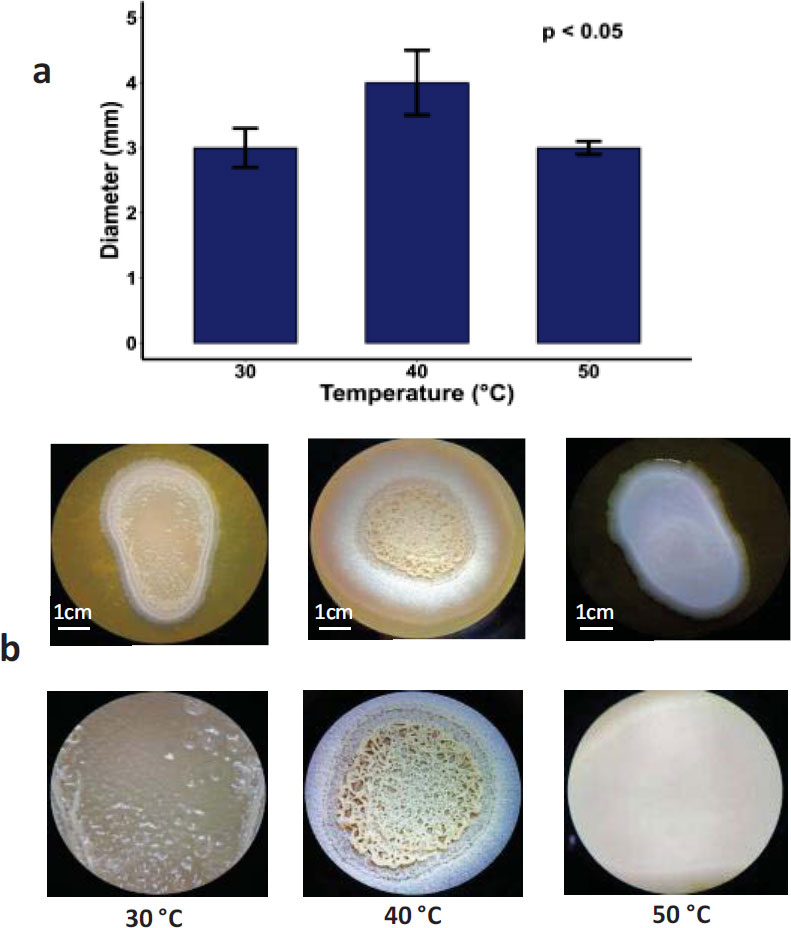
Diameter (a) and morphology (b) of Bacillus cereus TGS 11.1 colony biofilm grown at different temperatures.
The swarming motility of B. cereus TGS 11.1 exhibited significant variation relative to temperature, reaching a peak diameter of 4.4 ± 0.5 cm at 40°C (Fig. 5). At this optimum, the motility zone displayed vigorous expansion and branching patterns, whereas swarming capacity was significantly impaired at 30°C (3.2 ± 0.3 cm) and 50°C (3.4 ± 0.3 cm). The positive correlation between maximum swarming motility and peak optical density at 40°C suggests that elevated motility facilitates surface coverage, a prerequisite for subsequent biofilm accumulation in milk-processing environments. These results align with established reports regarding optimal temperatures for Bacillus motility [18, 19] and surface translocation [20].
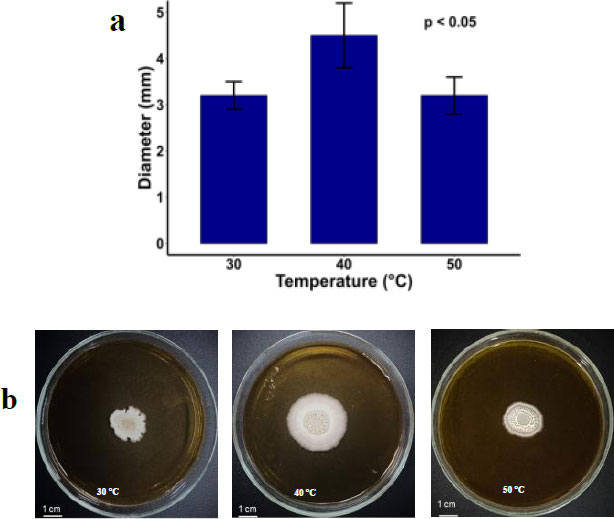
Motility zone diameter (a) and swarming motility (b) of the Bacillus cereus TGS 11.1 strain’s colony grown at different temperatures.
4. STUDY LIMITATIONS
Although this study establishes a robust predictive model for the synergistic effects of environmental factors on Bacillus cereus TGS11.1 biofilm formation using RSM-CCD, a few limitations should be noted. First, while the in vitro static model successfully characterized baseline physiological responses, it does not fully simulate the dynamic fluid flows and multi-nutrient milk matrices characteristic of commercial processing lines. Second, this investigation focused on a single, high-risk, heat-resistant isolate from raw milk to ensure controlled experimental consistency; however, alternative strains may exhibit variations due to intra-species diversity.
CONCLUSION
This study was conducted to evaluate the impact of environmental factors, including temperature (30°C, 40°C, 50°C, 60°C, and 70°C), pH (4, 5, 6, 7, and 8), lactose concentration (2%, 3%, 4%, 5%, and 6%), and incubation time (12, 24, 36, 48, and 60 h), on the biofilm formation of the Bacillus cereus TGS 11.1 strain. Among the variables tested, temperature, pH, and lactose concentration significantly influenced biofilm development. Notably, temperature emerged as the most critical factor, with the highest biofilm productivity observed at 40°C. At this temperature, the strain exhibited its most complex biofilm architecture, characterized by a dense three-dimensional (3D) network and peak motility-driven attachment. Based on these findings, it is highly recommended to avoid prolonged exposure to temperatures around 40°C during the processing and storage of milk and dairy products to mitigate the robust biofilm formation of the Bacillus cereus TGS 11.1 strain.
AUTHORS' CONTRIBUTIONS
The authors confirm their contributions to this paper as follows: B.T.V.: Responsible for the conception and design of the study; B.H.B.T.: Performed experiments, contributed to methodology, and participated in manuscript revision; T.H.T.H.: Responsible for data collection, statistical analysis, and participated in manuscript revision; T.V.B.: Contributed to data analysis and assisted in manuscript revision.; T..K.D.H.: Provided support with equipment and infrastructure for the experiments; K.A.T: Supervised the project and provided critical review.
LIST OF ABBREVIATIONS
| BHI | = Brain Heart Infusion |
| CCD | = Central Composite Design |
| CV | = Crystal Violet |
| EPS | = Exopolysaccharides |
| LB | = Luria-Bertani |
| OD | = Optical Density |
| ODc | = Optical Density Control |
| PBS | = Phosphate-Buffered Saline |
| RSM | = Response Surface Methodology |
| SD | = Standard Deviation |
| 3D | = Three-dimensional |
AVAILABILITY OF DATA AND MATERIALS
The data supporting the findings of the article is available from the corresponding author [B.T.V], upon reasonable request.
ACKNOWLEDGEMENTS
The authors would like to express their sincere gratitude to the Institute of Advanced Technology, Vietnam Academy of Science and Technology, Vietnam, for providing the laboratory facilities and technical support necessary to conduct this research.