All published articles of this journal are available on ScienceDirect.

Antiviral Therapy for Measles: Progress, Challenges and Perspectives
 iD
Walid Belhaimer1 , *
iD
Mahamadou Moustapha Sani Daouda1 , 2 , *
, #
iD
Djibrill Garba Kalla1
iD
Sadia Tina1 , 2
iD
Fatima Azzahra Lahlou4
iD
Samy Iskandar1
iD
Meryam El Jemli1
iD
Lamia Slimani2 , 3 , 4
iD
Moulay Mustapha Ennaji5
iD
Mohamed Kettani Halabi1 , 2 , 4 , 5
iD
iD
Walid Belhaimer1 , *
iD
Mahamadou Moustapha Sani Daouda1 , 2 , *
, #
iD
Djibrill Garba Kalla1
iD
Sadia Tina1 , 2
iD
Fatima Azzahra Lahlou4
iD
Samy Iskandar1
iD
Meryam El Jemli1
iD
Lamia Slimani2 , 3 , 4
iD
Moulay Mustapha Ennaji5
iD
Mohamed Kettani Halabi1 , 2 , 4 , 5
iD
Authors Info & Affiliations
Abstract
Introduction/Objective
Despite the availability of an effective vaccine, measles remains a major cause of pediatric morbidity and mortality worldwide. This review aims to evaluate advances toward the development of specific antiviral treatments for measles by examining current candidates, their molecular targets, available preclinical and clinical data, and key challenges to therapeutic application.
Methods
An extensive literature search (2000-2026) was conducted using PubMed and official databases (WHO, CDC), including in vitro and in vivo studies (animal models), clinical trials, and international guidelines. The main agents included were ribavirin, favipiravir, remdesivir, ERDRP-0519, GHP-88309, fusion peptide inhibitors, and monoclonal antibodies.
Results
No antiviral is yet approved specifically for measles; however, several candidates show promise. Ribavirin, a broad-spectrum antiviral, has demonstrated in vitro inhibition of measles virus and clinical benefit in severe cases (especially in immunocompromised patients), although data remain limited. Novel polymerase inhibitors such as ERDRP-0519 and its derivative GHP-88309 have shown effective post-exposure protection in animal models. Nucleoside analogs initially developed for other viruses (favipiravir, remdesivir) exhibit in vitro anti-measles activity. Peptides and monoclonal antibodies targeting the viral fusion protein also demonstrate encouraging results.
Discussion
Antiviral therapy may improve the management of severe or post-exposure cases, especially in non-vaccinable individuals.
Conclusion
While vaccination remains the cornerstone of prevention, antiviral therapy may improve the management of severe or post-exposure cases, especially in non-vaccinable individuals. Clinical trials are needed to validate these strategies and consider their integration into future global measles elimination programs.
1. INTRODUCTION
Measles is a highly contagious acute viral infection caused by the measles virus (Measles morbillivirus, MeV), a single-stranded RNA paramyxovirus [1]. Despite the decades-long availability of an effective live attenuated vaccine (with global coverage around 85%), measles still caused nearly 140,000 deaths in 2018 and over 200,000 in 2019 during a global resurgence [2]. Mortality primarily affects malnourished children under the age of five and immunocompromised individuals [3]. Beyond the acute phase, whose case fatality rate is approximately 0.1–1%, measles induces a transient yet profound immunosuppression, sometimes referred to as “immune amnesia,” through depletion of the host’s memory lymphocytes [4]. This results in increased susceptibility to other infections over the months and years following measles, contributing indirectly to childhood mortality [5]. No specific antiviral treatment has yet been approved for measles. Standard care is based on supportive measures (hydration, antipyretics) and vitamin A supplementation, which is recommended by the WHO in children to reduce the risk of ocular, diarrheal, and respiratory complications [6]. In cases of exposure, the only recognized post-exposure prevention methods include administration of the Measles-Mumps-Rubella (MMR) vaccine within 72 hours or, when contraindicated or delayed, administration of polyclonal anti-measles immunoglobulins within six days [7]. These passive prophylactic measures can significantly reduce the severity of illness when used promptly, although they do not replace long-term immunization [8]. In this context, developing antiviral therapies targeting MeV could serve several purposes: (i) treatment of severe forms (such as pneumonia or encephalitis) in high-risk patients, namely infants too young to be vaccinated and immunocompromised individuals who cannot effectively clear the virus [9]; (ii) post-exposure prophylaxis beyond the 3-6-day window of vaccine or immunoglobulin efficacy, for instance during outbreaks in under-vaccinated populations [10]; and (iii) treatment of delayed complications related to persistent infection, such as Subacute Sclerosing Panencephalitis (SSPE), a fatal neurodegenerative disorder occurring years after measles [11]. In recent years, several factors have revived interest in an antiviral approach: the resurgence of measles in regions where it had previously been eliminated (e.g., outbreaks in Europe in 2018-2019) [12]; increased vulnerability of unvaccinated children due to COVID-19-related disruptions in vaccination programs [13]; and the availability of new broad-spectrum antiviral molecules initially designed for other viruses (e.g., RSV, influenza, SARS-CoV-2) [14]. Advances in molecular virology have also enabled the identification of specific therapeutic targets within the measles genome, opening avenues for rational drug design and a precision medicine approach to measles treatment [15].
2. METHODOLOGY
This narrative review is based on a literature search conducted through PubMed and official databases (WHO, CDC) up to 2026, using both English and French keywords such as “measles” / “rougeole,” “antiviral therapy,” “treatment,” “ribavirin,” “favipiravir,” “remdesivir,” and “monoclonal antibody.” Selected publications included experimental studies (in vitro and in vivo in animal models), clinical trials, case reports, as well as official reference guidelines (WHO, CDC). The review focused on extensive literature research (2000-2026) and on data deemed relevant to therapeutic evaluation. The objective was to provide a critical and qualitative synthesis of the current state of knowledge.
3. VIRAL TARGETS AND MECHANISMS OF ACTION OF ANTI-MEASLES ANTIVIRALS
To develop effective antiviral agents, it is essential to identify viral components that are vulnerable to pharmacological inhibition. Measles virus (MeV) possesses several proteins that are critical to its replication cycle (Fig. 1):
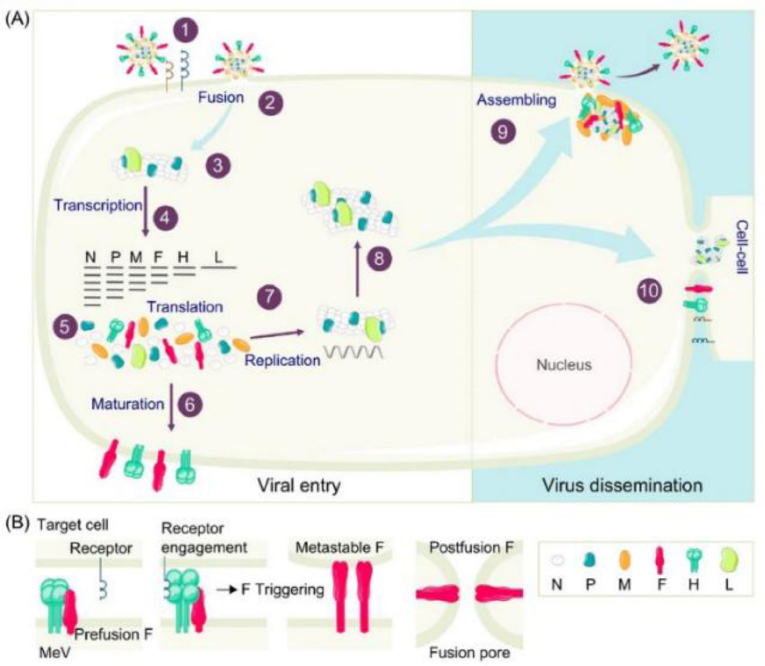
Life Cycle of Measles Virus “Reproduced from Ferran et al., Viruses, 2019 under the terms and conditions of the Creative Commons Attribution (CC BY) license (https://creativecommons.org/licenses/by/4.0/) [28].”
(A) In order to infect a susceptible, receptive cell, MeV first binds to its entry receptors located on the cell surface (1), then triggers fusion between its envelope and the host cell membrane (2), as detailed in (B). This fusion allows the viral genome to enter the cytoplasm (3). The viral RNA is then transcribed into mRNA (4), which is translated into viral proteins (5). As they are transported to the plasma membrane, the viral glycoproteins mature (6). At the same time, replication of the positive-strand antigenomic RNA begins in the cytoplasm (7) and serves as a template for the synthesis of a new negative-strand genomic RNA (8). Finally, the viral proteins assemble at the cell surface, leading either to the budding of new virions (9) or to fusion between neighboring cells (10).
(B) The MeV hemagglutinin (H) protein first binds to its receptor on the surface of the target cell, which activates the fusion protein (F) into a metastable state. The F protein then inserts its fusion peptide into the cell membrane and undergoes several conformational changes that gradually bring the two membranes closer together until they fuse. This fusion results in the formation of a pore through which the viral ribonucleocapsid (RNP) is released into the cytoplasm.
3.1. Envelope Glycoproteins H and F
The hemagglutinin (H) protein binds to cellular receptors (CD150/SLAM on immune cells and Nectin-4 on respiratory epithelial cells) [16], while the fusion (F) protein mediates the fusion of the viral envelope with the host cell membrane, enabling viral entry. These surface proteins are the targets of naturally neutralizing antibodies and thus represent prime candidates for therapies using monoclonal antibodies or fusion-inhibitory peptides. For example, an experimental monoclonal antibody called mAb 77, directed against the F protein, blocks the conformational change required for fusion and thereby neutralizes the virus in vitro [17]. Likewise, synthetic peptides mimicking specific regions of the F protein can insert themselves into the fusion machinery and prevent membrane fusion [18].
3.2. RNA Replication Complex
Since MeV has a negative-sense single-stranded RNA genome, it encodes an RNA-dependent RNA polymerase (the L protein), assisted by a cofactor (P protein), which carries out genome transcription and replication in the cytoplasm [19]. This viral polymerase, which has no homolog in host cells, is a strategic target for direct-acting antivirals. Nucleoside analogs such as ribavirin and favipiravir mimic natural nucleotides, leading to either lethal mutagenesis or premature chain termination of viral RNA synthesis [20]. In contrast, non-nucleoside inhibitors bind directly to the L protein, altering its structure. The experimental inhibitor ERDRP-0519, for example, binds to an allosteric pocket in the transferase domain of the L protein, blocking both the initiation and elongation phases of RNA synthesis [21]. These inhibitors are highly specific to the measles polymerase, minimizing the risk of interference with host cellular functions [22].
3.3. Assembly and Budding
Other potential targets include the matrix (M) protein, involved in virion assembly and budding at the host membrane, and the viral C protein (Non-structural C protein), which modulates the interferon response. However, to date, no advanced antiviral candidate has targeted these late-stage processes, likely because interfering with measles virus assembly is particularly complex [23]. In practice, most candidate antivirals against measles focus on two main stages: viral entry (targeting H and F proteins) and RNA replication (targeting the L protein). Mechanisms of action vary and include fusion inhibition (via antibodies or peptides), RNA polymerase inhibition (nucleoside and non-nucleoside), and disruption of viral transcription and genome replication [24-27].
4. CURRENT STATUS OF KEY ANTIVIRAL CANDIDATES FOR MEASLES
Several compounds with diverse pharmacological profiles have been studied as potential treatments for measles. Below is an overview of the main candidates:
4.1. Ribavirin – a Broad-spectrum Nucleoside Analog
Ribavirin is a guanosine analog phosphorylated by host cells and known for its antiviral activity against many RNA viruses (e.g., hemorrhagic fevers, respiratory syncytial virus) [29]. In vitro, it inhibits measles virus replication in cell culture [30]. Its dual mechanism includes incorporation into viral RNA, causing lethal mutations, and an immunomodulatory effect enhancing Th1 responses [31]. In clinical practice, ribavirin has been used compassionately in severe measles cases. A randomized clinical trial conducted in 1981 involving 100 patients (aged 6 months to 47 years) demonstrated that oral ribavirin (20 mg/kg/day for 7 days) significantly reduced fever duration (3.2 ± 0.6 days vs. 7.3 ± 0.8 days in the placebo group) and the risk of complications (0% pneumonia with ribavirin vs. ~50% in the control group), with no deaths in the treated group compared to 16% mortality among controls [32]. These early results suggested a significant clinical benefit. Subsequently, several case reports and series have documented ribavirin use in immunocompromised patients with measles. In children with leukemia or post-transplant, who may experience mortality rates as high as 30-70%, ribavirin (intravenous or aerosolized) was associated with rapid defervescence and improved survival compared to the natural history of the disease [33]. Similarly, in immunocompetent adults, case series of severe measles pneumonia treated with intravenous ribavirin suggested faster clinical improvement than with standard care [34]. However, no recent large-scale controlled trials have confirmed these findings, and ribavirin has notable adverse effects, including dose-dependent hemolytic anemia and fetal toxicity, limiting its widespread use. To date, it is not specifically approved for measles, and its use remains off-label in selected high-risk cases [35].
4.2. Favipiravir (T-705) – an Oral Antiviral Targeting RNA Polymerases
Favipiravir is a guanine analog prodrug originally developed for influenza (and approved in Japan), with broad-spectrum activity against various RNA viruses, including flaviviruses, bunyaviruses, and alphaviruses [36]. For measles, Japanese studies have shown that favipiravir inhibits MeV replication in vitro, with half-maximal effective concentrations (EC50) ranging from 40 to 100 µM-comparable to those of ribavirin [36]. Notably, it also inhibits replication of SSPE-derived strains (persistent mutant viruses isolated from the brain) in cell culture [37]. Favipiravir is converted by host cells into a ribonucleotide form that blocks the viral RNA polymerase catalytic site, leading to termination of viral transcription [38, 39]. Although there are no documented human uses of favipiravir for measles to date, its oral formulation and experience during Ebola and COVID-19 outbreaks make it a promising candidate for clinical trials in measles. Its use could be considered for exposed individuals or during early infection to reduce viral load before the onset of cytokine storm and immune amnesia. While no animal studies in measles models (e.g., monkeys) have yet been published, favipiravir has shown efficacy in vivo against related morbilliviruses, such as the small ruminant plague virus [40, 41]. Its main limitations include teratogenicity (a strict contraindication in pregnancy, as with ribavirin) and the need for high dosing in certain viral infections.
4.3. Remdesivir (GS-5734) – Broad-spectrum Nucleotide Analog Antiviral
Widely known for its use against COVID-19, remdesivir is a modified adenosine analog that incorporates into viral RNA during replication, leading to premature termination. It was initially shown to be effective against Ebola virus in primates and exhibits in vitro activity against various RNA viruses, including paramyxoviruses such as Hendra, Nipah, and respiratory syncytial virus [42]. Regarding measles virus, its antiviral potential has been suggested by modeling studies, but experimental data remain limited. A recent study evaluated remdesivir for post-exposure prophylaxis in rhesus macaques infected with wild-type measles virus. Daily intravenous administration of remdesivir starting three days after infection temporarily suppressed viral RNA in blood during treatment, but did not prevent clinical disease after treatment cessation (the animals eventually developed clinical measles) [43]. In other words, remdesivir delayed and reduced viremia but failed to eradicate the virus in primates, suggesting that at the tested dose, it acts virostatically rather than virocidally. This study highlights that remdesivir alone, administered on day 3 post-exposure (which corresponds to the end of the incubation period in monkeys), is insufficient to fully alter the course of measles [43]. Furthermore, the need for prolonged intravenous administration makes its use impractical in the context of measles, which is typically managed at home unless complications arise. Nevertheless, its impact on viremia confirms the druggability of the measles polymerase by nucleotide analogs and justifies the search for better oral compounds with improved bioavailability and efficacy. Oral molecules such as molnupiravir (EIDD-2801, another nucleoside analog authorized against SARS-CoV-2) could, for example, be evaluated for measles in the future, although no published data were available as of 2026 [44].
4.4. Non-nucleoside Polymerase Inhibitors (ERDRP- 0519, GHP-88309) – Experimental Antivirals Specific to Morbilliviruses
ERDRP-0519 is the lead compound from a series of small molecules discovered in the late 2000s that target the L polymerase of measles virus and related morbilliviruses [45]. Its unique mechanism of action involves locking the polymerase enzyme in an inactive conformation, preventing the formation of phosphodiester bonds during RNA synthesis [46]. Initially tested against canine distemper virus (a closely related morbillivirus) in ferrets, oral administration of ERDRP-0519 provided complete protection from an otherwise lethal infection when given as post-exposure prophylaxis at the onset of viremia (three days post-infection) [47]. All treated animals survived without clinical symptoms and even developed protective immunity (seroconversion), suggesting that the attenuated virus under treatment may have acted like a “vaccination”. This breakthrough, published by Krumm et al. in 2014, demonstrated that an antiviral could cure an acute morbillivirus infection in a laboratory animal [48]. ERDRP-0519 was later optimized for potency and duration of action, resulting in the derivative GHP-88309 [49]. This compound has extended activity against other paramyxoviruses and excellent oral efficacy, with a prolonged tissue half-life [50]. In a ferret model infected with a highly pathogenic canine distemper virus, GHP-88309 (50 mg/kg twice daily orally) not only rescued all animals when treatment was initiated as late as 5-7 days post-infection, but also prevented measles-associated immune amnesia [51]. Specifically, starting treatment on day 5 (corresponding to the onset of rash and viremia in ferrets) suppressed viral load and allowed for rapid immune recovery (peripheral lymphocytes did not collapse as in control animals) [52]. However, initiating treatment on day 7 (more advanced infection) was too late to save all animals [53]. These results, published by Cox et al. in 2024 and Wolf et al. in 2024, define how far the antiviral intervention window can be extended with a potent inhibitor: up to about one week after infection for full protection [51, 54]. No significant resistance was observed in these studies (rare escape mutants bore L protein mutations that impaired viral fitness). While ERDRP-0519 and GHP-88309 have not yet entered human clinical trials and require regulatory toxicology studies, they represent a proof of concept that oral post-exposure antiviral therapy is feasible against measles, potentially transforming future outbreak management.
4.5. Fusion-inhibitory Peptides – F Protein Mimetics Blocking Viral Entry
Paramyxoviruses (including measles) require conformational rearrangement of the F protein from a prefusion to postfusion state for membrane fusion. Small peptides corresponding to F protein helical sequences can interfere with this process. For measles, several peptides derived from the C-terminal HR2 region of the F protein have been developed. When administered intranasally, they integrate into intermediate fusion complexes and prevent membrane fusion. Mathieu et al. showed that an optimized peptide modified with a cholesterol group (to enhance anchoring to respiratory membranes) could completely protect laboratory animals from measles infection: in a humanized mouse model, nasal instillation of the peptide a few hours before aerosolized infection prevented any measurable viral replication [55]. More recently, in 2022, Reynard et al. evaluated a peptide named HRC4 delivered via nebulizer to cynomolgus macaques before and after intratracheal measles virus infection [56]. Aerosol therapy was well tolerated and resulted in complete absence of viral replication or clinical signs in treated monkeys, whereas untreated animals developed measles. Treated animals did not even develop antibodies, indicating that infection was blocked at the implantation stage. These anti-F peptides, conceptually similar to enfuvirtide (against HIV) or VIR-7831 (against RSV), are being considered as emergency prophylactics. Their use must be extremely early, ideally immediately post-exposure, as they are only effective at preventing the initial implantation of the virus. As such, their application would target unvaccinated contacts (e.g., infants too young or immunocompromised individuals who cannot receive the vaccine) [57]. Challenges include large-scale peptide production, stability, and optimal delivery to the respiratory tract. Nonetheless, these fusion inhibitors represent an innovative strategy complementary to conventional antivirals.
4.6. Monoclonal Antibodies – Passive Immunotherapy Targeting H or F Proteins
Currently, standard polyclonal immunoglobulins (derived from human plasma) are used for post-exposure prophylaxis to prevent severe disease in high-risk individuals, ideally administered within 6 days of contact [58]. These Ig preparations provide partial passive immunity. The development of humanized monoclonal antibodies specifically targeting measles virus aims to deliver consistent, high-potency neutralizing antibodies. Antibodies targeting the H or F protein have been studied. For example, an experimental antibody named mAb 77, directed against the prefusion form of the F protein, has demonstrated the ability to block the final step of membrane fusion and neutralize the virus in cell culture [24]. Such antibodies could be administered in a single injection to unvaccinated exposed individuals (to prevent infection) or to immunocompromised patients with active measles to assist in viral clearance. Although no anti-measles monoclonal antibody is yet available for clinical use, this approach follows the successful model of antibody-based therapies in other viral diseases (e.g., palivizumab for RSV). Combined with classical antivirals, passive immunotherapy could offer a dual benefit: reducing viral load and neutralizing circulating virions. The main characteristics of the antiviral candidates discussed in this review are summarized in Table 1.
| Name | Classification | Dosage | Route of Administration |
|---|---|---|---|
| Ribavirin | Synthetic nucleoside analog (guanosine analog) | depends on body weight | Oral, inhalation, and intravenous |
| Favipiravir (T-705) | pyrazinecarboxamide derivative and nucleoside analog | Based on the viral infection | Mainly oral, Option for intravenous |
| Remdesivir (GS-5734) | Nucleotide Prodrug- RNA-Dependent RNA Polymerase (RdRp) Inhibitor | Depends on age | Intravenous |
| Non-Nucleoside Polymerase Inhibitors (ERDRP-0519, GHP-88309) | Non-nucleoside inhibitors | Not established in humans | Not established in humans |
| Fusion-Inhibitory Peptides – F Protein Mimetics Blocking Viral Entry | Alpha-helical peptides, hydrophobics | Depends on the specific peptide’s half-life and potency | Subcutaneous, Inhalation or Intranasal |
| Monoclonal Antibodies – Passive Immunotherapy Targeting H or F Proteins | Immunoglobulins | Based on body weight and half-life extension mutations | Intravenous or Intramuscular |
5. CLINICAL AND PRECLINICAL DATA
5.1. Broad-spectrum Molecules (Ribavirin, Favipiravir, Remdesivir)
Direct clinical evidence is limited. Among these, ribavirin is the most thoroughly documented. The randomized clinical trial conducted in 1981, as previously mentioned, showed a reduction in measles duration and severity in treated children [59]. In addition, several reports in immunocompromised patients suggest that ribavirin (administered intravenously or by aerosol) may improve outcomes. For instance, Kaplan et al. reported in 1992 that leukemic patients with severe measles treated with ribavirin experienced rapid defervescence and lower mortality compared to historical data (case fatality reduced from ~70% to 36%) [60]. Similarly, a case series of adults with severe measles pneumonia treated with intravenous ribavirin demonstrated clinically significant improvement compared to untreated cases [61]. However, no recent controlled studies have confirmed these observations, and the use of ribavirin remains controversial due to its toxicity. In contrast, favipiravir has so far only been evaluated in preclinical studies. Hashimoto et al. confirmed its antiviral activity on measles and SSPE virus cultures [16], but no in vivo data are yet available. Nevertheless, indirect evidence from related viruses exists: favipiravir has shown efficacy against several paramyxoviruses (e.g., mumps virus, Nipah virus) in animal models [62, 63], suggesting its potential utility against measles. As for remdesivir, the only primate study (in rhesus monkeys) produced mixed results: post-exposure administration temporarily reduced blood viral load but did not prevent the onset of disease [64]. No clinical use of remdesivir in measles has been reported, and its practical interest appears limited due to its injectable form and narrow therapeutic window. In summary, among the broad-spectrum agents, ribavirin remains the only one with occasional clinical indications (in severe cases), albeit off-label, while favipiravir and remdesivir require further investigation [65].
However, the combination of Brequinar, a new target identified in 2026, and Remdesivir has shown an additive antiviral effect against the measles virus [66]. The study published by Yang Wang et al. in June 2026 described Brequinar as a potent inhibitor of measles virus replication. Unlike ERDRP-0519, which directly targets the virus, Brequinar acts on the host cell by inhibiting pyrimidine biosynthesis, thereby reducing the nucleotides necessary for viral replication and significantly curbing viral multiplication in human cells [66].
5.2. Polymerase-specific Inhibitors (ERDRP-0519, GHP-88309)
All data concerning these agents come from preclinical research. ERDRP-0519 initially demonstrated efficacy in the lethal canine distemper virus model in ferrets, achieving 100% survival in treated animals versus 0% in controls [45]. This remarkable result was later confirmed and extended with the optimized derivative GHP-88309. Cox et al. (2024) showed that this compound completely protected ferrets, even when treatment began at the onset of symptoms (up to five days post-infection) [51]. Other studies also demonstrated that treated ferrets did not experience the massive lymphocyte depletion typically induced by the virus, an indication that the antiviral suppresses viral replication rapidly enough to prevent measles-induced immunosuppression [67]. No dose-limiting toxicity was observed in animals at effective concentrations, and resistance studies only identified polymerase mutants with severe fitness impairments (and thus unlikely to spread) [68]. These preclinical results position GHP-88309 as a serious candidate for development. The next step would be phase I human trials to assess safety and pharmacokinetic profiles. If successful, efficacy studies could follow in the context of measles outbreaks (e.g., as post-exposure treatment in unvaccinated contacts) [69]. It should be noted that, as of 2026, these compounds are still in the prototype stage and have not yet entered human testing.
Cryo-electron microscopy studies have made it possible to precisely determine the binding site of ERDRP-0519 on the measles virus polymerase. This discovery, published in 2025 by Wang et al., paves the way for the optimization of even more potent derivative molecules [45].
5.3. Fusion Inhibitors and Monoclonal Antibodies
Here as well, the available data are derived from animal models. Fusion-inhibitory peptides have demonstrated their capacity to prevent measles infection in vivo: in the macaque model, nebulized HRC4 peptide completely suppressed viremia and clinical symptoms [70]. These findings are highly promising for prophylactic use. However, no study has tested these peptides for the treatment of active measles, presumably because once the virus has disseminated (after rash onset), blocking new cell entries has limited therapeutic impact. In addition, Kobayashi et al. (2026) developed new short peptides derived from the HR2 region of the virus’s fusion (F) protein. These molecules, which are still in the experimental stage, prevent fusion between the virus and the cell and block the virus’s entry before replication begins [71].
As for monoclonal antibodies, they remain at an exploratory stage. Available data show potent in vitro neutralization, and measles animal model studies are anticipated. In the absence of specific monoclonal antibodies, clinical practice currently relies on polyclonal immunoglobulin administration. Retrospective analyses suggest that Ig administered within ≤6 days post-exposure reduces the likelihood or severity of disease, albeit incompletely [72]. For example, an older study from Finland showed that post-exposure vaccination within 72 hours prevents about 90% of cases, and Ig administered up to days 5-6 post-exposure either prevents or significantly attenuates measles in most recipients [72]. These findings support current recommendations (see section 8). A monoclonal antibody, if developed, could potentially offer more consistent protection than standard Ig preparations. In 2026, a research team funded by the National Institutes of Health (NIH) isolated and characterized the first comprehensive panel of human antibodies directed against the measles virus. The analyses revealed new insights into the human immune response to infection and identified antibodies capable of reducing the viral load to undetectable levels in an animal model. These data provide an experimental basis for the development of therapeutic strategies against measles [73].
In summary, passive immune strategies are already a cornerstone of prophylaxis (through Ig), and ongoing preclinical advances raise hopes for even more effective tools in the future, including humanized monoclonal antibodies.
6. CURRENT LIMITATIONS OF ANTIVIRAL APPROACHES
Despite encouraging progress, several limitations hinder the implementation of antiviral treatments for measles:
6.1. Narrow Therapeutic Window
Measles virus (MeV) replicates rapidly, reaching peak viral load before the onset of the rash. Delayed administration significantly reduces treatment efficacy, as demonstrated by the failure of remdesivir when initiated on day 3 post-infection in non-human primates [74].
Difficult targeting of high-risk populations: Most cases resolve spontaneously. Antivirals would be primarily justified in high-risk individuals (immunocompromised patients, infants, malnourished children) or during epidemic outbreaks [75].
6.2. Methodological Constraints
Clinical studies are limited and often dated. Conducting randomized trials in the context of outbreaks remains complex, especially given the low baseline mortality rate (<1%) [76].
6.3. Toxicity
Both ribavirin and favipiravir are teratogenic, limiting their use, particularly in pregnant women [77]. New compounds must demonstrate pediatric safety before being considered for widespread use [78].
6.4. Risk of Resistance
Although MeV is genetically stable, prolonged use of antivirals could promote the emergence of resistant mutants, as observed in some ERDRP-0519 studies [79].
6.5. Cost and Accessibility
High costs and logistical challenges (e.g., cold chain requirements for monoclonal antibodies) complicate deployment in the most affected regions [51].
In summary, anti-MeV antivirals will need to overcome biological, ethical, economic, and logistical barriers before they can be integrated into routine measles management.
7. THERAPEUTIC PERSPECTIVES
Despite the limitations mentioned, future prospects are encouraging thanks to accumulated knowledge and new technologies. Several strategic directions are being explored to improve therapeutic management of measles:
7.1. Development of “ready-to-use” Polymerase Inhibitors
The exceptional preclinical results of GHP-88309 in ferrets pave the way for a true antiviral drug against measles. If its safety is confirmed in humans, it could be envisioned for extended post-exposure prophylaxis during outbreaks: when administered up to one week after contact, it may suppress viral replication before symptom onset, preventing both disease in the exposed individual and secondary transmission [80]. Combined with vaccination, such an antiviral could help rapidly contain outbreaks by protecting unvaccinated contacts beyond the time window for effective immunization [80]. In the longer term, Shrestha et al. have suggested that an oral antiviral could accompany vaccination campaigns in hard-to-reach areas, offering immediate protection while immunity from the vaccine develops, thus contributing to measles eradication [81]. Though still hypothetical, this “treatment + vaccine” strategy illustrates the potential impact of an effective antiviral. Moreover, the polymerase inhibitor platform could be broadened to target other Paramyxoviridae viruses (e.g., Nipah or Hendra viruses). A pan-paramyxovirus polymerase inhibitor would be a valuable asset in global public health [82].
7.2. Repurposing of Existing Drugs
In addition to new molecules, the use of currently available drugs for other indications should be explored. For example, molnupiravir (an oral antiviral used against COVID-19) induces lethal mutagenesis in viral genomes and has shown activity against several respiratory RNA viruses; it would be relevant to test it against measles virus in preclinical models, considering its ease of administration [83]. Likewise, antivirals developed against other Paramyxoviridae (e.g., respiratory syncytial virus or parainfluenza viruses) could be evaluated for potential cross-activity [84]. Favipiravir, already approved in several countries and deployed during Ebola and COVID-19 outbreaks, could be the subject of a pilot clinical trial in severe measles [85]. Its advantages include oral administration and relative tolerability (outside pregnancy). Drug combinations may also offer synergistic effects; for instance, combining ribavirin (direct antiviral effect) with interferon-α (immunostimulatory effect) has been attempted in some SSPE cases and could be tested in disseminated measles in immunocompromised hosts [28, 85-87].
7.3. Immunomodulation and Host-support Strategies
Since measles induces transient immunosuppression, combining antivirals with immunomodulatory therapies is a promising concept. Systematic vitamin A supplementation is a simple, validated example: it reduces measles mortality by strengthening epithelial integrity and favoring a faster immune response [88]. High doses are already recommended for hospitalized children with severe measles and should continue to be promoted. Other immunomodulators could be explored: subcutaneous interferon may theoretically benefit immunocompromised patients unable to produce sufficient endogenous IFN, although its efficacy in acute measles is unproven and it carries side effects [89]. Agents such as levamisole or inosiplex (isoprinosine), which stimulate cellular immunity, have been used empirically in SSPE and occasionally in prolonged measles infections; inosiplex has shown some survival benefit in SSPE [90], suggesting a potentially useful immunomodulatory effect. While these drugs do not act directly on the virus, they may enhance host response and serve as useful adjuncts to antiviral therapy.
7.4. Treatment of Subacute Sclerosing Panencephalitis (SSPE)
SSPE remains incurable in most cases, with a grim prognosis. Nonetheless, some combined regimens have shown survival prolongation: intraventricular interferon-α combined with oral inosiplex has led to temporary disease stabilization in certain patients [91]. Similarly, intrathecal ribavirin has been trialed by Garg & Pandey with reports of transient partial remission [92]. In the future, new antivirals could be evaluated for SSPE. One challenge is delivering them effectively to the brain: favipiravir, which penetrates the CNS well, would be a logical candidate for SSPE trials [93]. Preclinical studies are underway using SSPE animal models. Furthermore, better understanding of SSPE pathogenesis (a persistent infection caused by mutant measles virus) may yield novel therapeutic targets. For example, modulating autophagy or chronic inflammatory responses in the brain alongside antiviral therapy could improve outcomes. Although rare, SSPE is a compelling reason to pursue antiviral development for measles, as it represents the most severe complication to prevent or treat.
7.5. Combination Therapies
As with other viral infections (e.g., HIV, hepatitis C), no single antiviral is likely to be a panacea. Future strategies may rely on combination therapies: for example, pairing a polymerase inhibitor with an anti-F monoclonal antibody [94]. The former would rapidly reduce viral load, while the latter would neutralize circulating virions and immediately protect uninfected cells. Such a combination could be administered to exposed immunocompromised individuals to ensure near-instant protection (via antibody) while controlling replication (via antiviral). Similarly, a fusion-inhibitory peptide could be combined with a systemic antiviral [95]. In vitro studies using tissue cultures could assess such synergies. The goal would be to completely halt infection progression in exposed individuals, a “flash virologic cure” approach, which, in the context of measles, could also protect close contacts given the virus’s extreme contagiousness [96].
In summary, therapeutic prospects for measles lie in the development of specific new molecules as well as in the repurposing and optimization of existing strategies, with a growing trend toward combined and integrated approaches. Future protocols, if developed, will likely include a direct-acting antiviral alongside adjuvant measures (e.g., immunomodulators, vitamin A), tailored to the patient’s profile. Measles also provides a valuable model to anticipate management strategies for other highly contagious emerging viruses: investment in anti-measles antivirals could thus have broader implications for medical virology.
8. CURRENT WHO AND CDC RECOMMENDATIONS
In the absence of approved antivirals, international health agencies focus their recommendations on prevention and supportive care. Both the World Health Organization (WHO) and the U.S. Centers for Disease Control and Prevention (CDC) emphasize that vaccination remains the most effective way to prevent measles and its complications [97]. The two-dose MMR (measles-mumps-rubella) vaccine schedule (at 12 and ~18 months) induces long-lasting immunity in over 95% of individuals [98]. National programs should aim for ≥95% coverage to achieve elimination.
In case of exposure to a confirmed measles case, the official recommendations are:
- Administer a dose of MMR vaccine within 72 hours to susceptible, unvaccinated individuals. This “emergency vaccination” is effective in preventing illness in a significant proportion of cases [99]. Being a live attenuated virus, the vaccine elicits an immune response faster than wild-type MeV causes disease, provided it is given early [100].
- If more than 72 hours have passed, or if vaccination is contraindicated (e.g., in immunocompromised individuals or pregnant women), administer standard immune globulin (IG) intramuscularly or intravenously within 6 days of contact [101]. The recommended dose is 0.25-0.5 mL/kg IM or 400 mg/kg IV, to provide immediate passive immunity. Historical studies showed that IG administration up to day 5 post-exposure significantly reduced clinical measles incidence and severity when infection occurred [102]. The CDC specifies that recipients of IG should still be vaccinated later (at least 6-8 months afterward) due to potential interference with the vaccine response [102].
For the treatment of active measles cases, WHO and UNICEF have recommended vitamin A supplementation since 1994 for all children with acute measles, especially in low-resource settings [6]. The standard regimen is 200,000 IU per day for 2 days (100,000 IU for infants aged 6-12 months, 50,000 IU for infants under 6 months) [96]. Supplementation has been shown to significantly reduce mortality by decreasing the risk of ocular complications (e.g., keratitis, blindness) and severe pneumonia [96]. In regions with prevalent vitamin A deficiency, this simple intervention has saved countless lives and remains a cornerstone of measles care. Beyond vitamin A, current recommendations emphasize optimal supportive care: adequate hydration, proper nutrition, antipyretic treatment of fever, and management of bacterial superinfections when necessary (e.g., antibiotics for otitis media or secondary bacterial pneumonia) [103]. Respiratory isolation of the patient during the infectious period (4 days before and after rash onset) is imperative to prevent nosocomial or household transmission [102]. Neither WHO nor CDC currently recommend the routine use of ribavirin or any other antiviral for acute measles [7]. The CDC acknowledges that some experts may consider ribavirin in extremely high-risk cases (e.g., leukemia, transplant recipients) [7], but this remains off-label and dependent on case-by-case clinical judgment. Likewise, WHO clinical manuals do not include specific antiviral treatments beyond post-exposure immunoglobulin. In conclusion, current guidelines prioritize vaccination, case isolation, post-exposure prophylaxis, and nutritional support (vitamin A). This approach has proven highly effective in reducing measles mortality over recent decades [74]. The future introduction of a safe and effective antiviral would likely complement, rather than replace, these foundational measures. International health agencies are closely monitoring research progress, and any validated antiviral may eventually be incorporated into outbreak control strategies alongside vaccination and immune globulin [14].
CONCLUSION
Although measles is largely preventable through vaccination, it remains responsible for numerous complications and deaths, particularly among vulnerable populations. In the context of epidemic resurgence and suboptimal vaccine coverage, specific antiviral strategies represent a promising complementary approach. Agents such as ribavirin, favipiravir, and polymerase inhibitors (ERDRP-0519, GHP-88309) have demonstrated encouraging potential, especially for post-exposure prophylaxis or the treatment of severe cases [51]. While no antiviral has yet been approved, preclinical progress suggests that targeted antiviral therapy could, in the near future, strengthen the fight against measles in synergy with current tools (vaccine, vitamin A, immune globulins). Such an integrated approach could not only reduce measles-related morbidity but also help accelerate the achievement of global elimination goals.
AUTHORS’ CONTRIBUTIONS
The authors confirm their contributions to the manuscript as follows: M.K.H., S.O., W.B.: Conceptualization; M.K.H., S.O., W.B.: Methodology; M.K.H., S.O., W.B., M.M.S.D.: Investigation; M.K.H., S.O., W.B., M.M.S.D., D.G.K, S.T., S.I., M.E.J., F.A.L., L.S., M.M.E.: Formal analysis; M.K.H., S.O, W.B.: Writing – original draft; M.K.H., M.M.S.D.: Writing – review and editing.
LIST OF ABBREVIATIONS
| C protein | = Non-structural C protein |
| CD150 | = Cluster of Differentiation 150 |
| CDC | = Centers for Disease Control and Prevention |
| CNS | = Central Nervous System |
| COVID-19 | = Coronavirus Disease 2019 |
| EC50 | = Half Maximal Effective Concentration |
| EIDD-2801 | = Molnupiravir or (2R,3S,4R,5R)-3,4- dihydroxy-5-(4-(hydroxyimino)-1,2-oxazin-3-yl) oxolan-2-yl)methyl isobutyrate |
| ERDRP-0519 | = 2-methyl-N-[4-[(2S)-2-(2-morpholin-4- ylethyl)piperidin-1-yl]sulfonylphenyl]-5- (trifluoromethyl)pyrazole-3-carboxamide |
| F Protein | = Fusion Protein |
| Favipiravir | = T-705 or 6-fluoro-3-hydroxy-2-pyrazinecarboxamide |
| GHP-88309 | = 2-Fluoro-6-(5-isoquinolinyl)benzamide |
| H Protein | = Hemagglutinin Protein |
| HIV | = Human Immunodeficiency Virus |
| HR2 Region | = C-terminal Heptad Repeat 2 Region |
| HRC4 | = Heptad Repeat C Region 4 |
| IFN | = Interferon |
| IG | = Immune Globulin |
| IM | = Intramuscular |
| Inosiplex | = Inosine Pranobex |
| IU | = International Units |
| IV | = Intravenous |
| L Protein | = Large Protein |
| M Protein | = Matrix Protein |
| mAb | = Monoclonal Antibody |
| mAb 77 | = Monoclonal Antibody 77 |
| MeV | = Measles Virus |
| MMR | = Measles-Mumps-Rubella |
| Nectin-4 | = Nectin Cell Adhesion Molecule 4 |
| P Protein | = Phosphoprotein P |
| Remdesivir | = GS-5734 or 2-ethylbutyl (S)-2-((1R,2R,3S,5R)-3- ((S)-2-ethylbutyl)-3-hydroxy-5-(phosphoramidate) cyclopentyl)-2-oxo-1,2,3,5- tetrahydropyrimidin-4-yl)acetamide |
| RNA | = Ribonucleic Acid |
| RSV | = Respiratory Syncytial Virus |
| SARS-CoV-2 | = Severe Acute Respiratory Syndrome Coronavirus 2 |
| SLAM | = Signaling Lymphocyte Activation Molecule (CD150) |
| SSPE | = Subacute Sclerosing Panencephalitis |
| Th1 | = T Helper 1 Cells |
| VIR-7831 | = Sotrovimab |
| WHO | = World Health Organization |
ACKNOWLEDGEMENTS
Declared none.